The cat sat on the floating mat as it travelled over the pin-prick houses of smoky London. Unfortunately, the corner of the mat got caught on a cloud so the mat began to unravel,
bit by bit, until the cat was sat on only air.
The cat went splat!

The cat sat on the floating mat as it travelled over the pin-prick houses of smoky London. Unfortunately, the corner of the mat got caught on a cloud so the mat began to unravel,
bit by bit, until the cat was sat on only air.
The cat went splat!
Lately, I have been spending a lot of my energy attempting to be a Lord of Time and, like any possible Timelord, I have been getting to grips with time and their relative dimensions in space. Now, you might think this is a quite straight forward thing to do as a writer but you would be wrong.
1)TIME is always the BIGGEST problem. You may have a job, family (particularly the young lively sort), pets, clubs, homework or household chores that always seem to demand your attention at the moment you settle down to write. It is very difficult to get to write with any or many of these in your life. Some may call these excuses but I challenge them to write anything with a three year old vomiting on their pencil. So, like myself, you may find it better not to schedule a particular time but rather take advantage of the odd 1/2 hour – hour that may arise throughout the day. Instead of watching that TV, reading a magazine or book (yes, I did say that), write. Being a Timelord demands sacrifice.
Even snippets of 5 or 10 minutes can be effectively used. Not for writing great reams but for imagining, asking what ifs, or as I have recently done, to jot down a key piece of exposition that you may forget.
2)RELATIVE – best avoided. They tend to take over your life when they visit or fill your imaginative quiet with noise. At worst, they are vocal critics. If you get yourself a useful, trained one, they might be of use as a cheap editor.
3)DIMENSIONS can be important. You are probably best going for ample room for paper, pen, laptop/tablet (if needed). Most important, leave plenty of room for snacks and coffee. Sacrifice personal comfort if necessary for the sake of coffee. It is the fuel that drives a Lord of Time. With enough, you will become transcendental in your writing and won’t notice the cramped space in the cupboard you are working in. If space is at a premium, I suggest something stronger than coffee.
4)SPACE can be a problem. Unless you are extremely well paid or fortunate to live in a relatively empty house, finding a quiet place to lock yourself away can be a problem. Sometimes you just have to make do even if it is a breakfast encrusted dinner table or on an unmade bed or in a cafe or on the back of the trained relative. A useful tactic is to choose a location without a tv or wifi, or if this isn’t possible, one with an annoyingly poor connection that makes you go through ridiculous procedural form filling to get just 2 minutes online. You will then soon no longer be tempted by such diversions. Remember, being a Timelord demands sacrifice.
So there you have my secrets of becoming a Timelord and going onto future success at getting something down on paper (using the toilet doesn’t count).

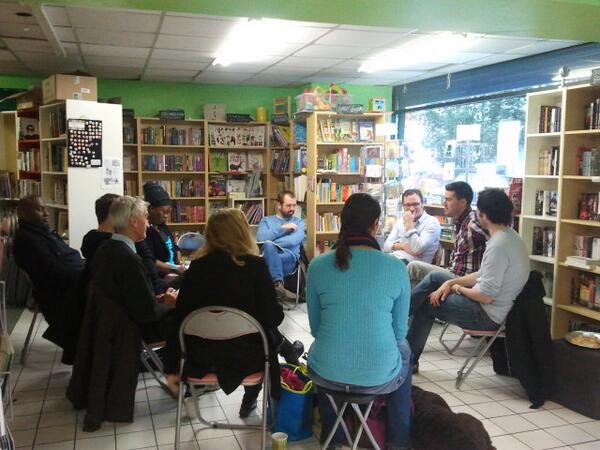
I recently was lucky enough to attend a workshop on How to Write Kids’ Fiction led by Joe Craig and Anthony McGowan as part of the Wood Green Literary Festival organised by the Big Green Bookshop. We were also fortunate enough to have Marianne Levy and Allan Boroughs (whose first book will be out next year) in the audience so there was a very good ratio of the published and would be published.
It was a very refreshing experience hearing from two writers of very different fiction. What came across was their thorough understanding of the genre they work in and enthusiasm for each other’s work as well as those trying to break through. What was of particular interest to me were their theories concerning structuring a narrative with an interesting protagonist – I guess it’s a hark back to the days when I studied Literature.
One of the points from Anthony McGowan that particularly intrigued me was the concept that the main character needs to be an orphan in some way. This is because parents or responsible adults would stop the protagonist from doing what they need to do. The orphan becomes a wanderer on their journey, receiving gifts from helpers on route. Eventually, there is a climatic battle before the end resulting in the orphan becoming a martyr somehow (my notes on this last bit aren’t great).
It struck me, that this is essentially what I did with my character Billy in my first book without realising it and got me wondering how many different ways a character can be an orphan. Here’s my list so far:
There are probably many more but I can’t think of them for the moment or of examples to go with a couple of my ideas. Perhaps you could suggest some.
I did some background reading on the orphan concept using Wikipedia and a study by Kimball . If anyone can suggest a source for a more contemporary take on this, I would be grateful.
Cheers
a single tear
white and crystalline
clings to the surface
making blue cold
still
a forest of alabaster
stands silent
almost unmoving
as air whispers dance
speaking of tales
of dead adventurers
from distant lands
stuck in time
compass frozen
before scurrying on
who will sing
a song for them now
the great polar spirit
cries alone
before leaping after
its bearded flesh
SILENCE This poem stemmed from me playing with a random word generator. I knew I wanted to write a “still” poem about the arctic but just need a few words to trigger a start even if I didn’t use them in the actual poem (which I didn’t).