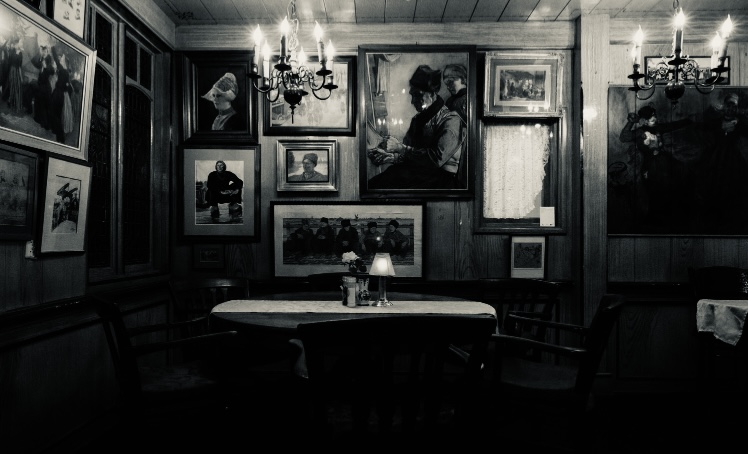
the son sat in the bar sipping his prosecco. he hated it here. the place smelt of damp dogs, wet people and two-day breath. why had he agreed to meet here? there were far better places. they could have met in the new artisan coffee house in town. great flat whites, free WIFI and young female barristas. here everyone was old. but then it had to be this place. he was more comfortable here. it was easier to say. waiting. he glanced at the menu of fish and chips, burger and chips, or steak. vegetarianism a thing of mystery. not even a lazy lasagne or penne pasta could be had. so he got another prosecco from the bar and a pack of stale ready salted crisps. that was lunch then. he stared at the bar a moment at the hopeful horseshoes hammered carelessly around the bar. and the collection of beer plates of ales they never had. what time was it? nearly twelve. he would be here soon. if anything was said of him, he was punctual. old school. no doubt, he would be dressed in shirt and tie, v-neck brown jumper, grey trousers and sensible shoes. he had worn the same for years. ever since he retired. it was a matter of duty. like collecting for the british legion, watching the queen’s speech, or buying the times. he was a man of timeless routine, of familiarity.
at precisely twelve, he came in, ordered a 1/2 of mild and sat opposite. this was it. the meeting. the important discussion they had to have, the son took a gulp of prosecco. what to say? how to say it? how do you say to a person it is time? so he just looked at him. waited. hoped he would say something first. nothing. he was always a man of few words. “dad?” “yes.” “did you read it?” “yes.” “you know it’s for the best.” “yes.” “and?” “it’s just the dog.” “we’ll find it a good home. you know we would take her but, you know, the cats.” “i know. it’s just…” “yes.” “it’s just I’ve had her so long. part of the family.” “i know. it’s just there is no option.” “i know.” “just, you know. i’m working all the time. it’s for the best.” “i know.” “we’re thinking of you.” “i know.” “it’s just…” “i know. just.”
mr higgins scooped the last of the insides out into the green plastic bucket. it had been a fruitful year. the display on the wall by the porch looked particularly good this year. sat in a row. images lit up. arresting. just the right note for the season. surely, he would win spookiest house again this year. not that anyone would tell him. folks tended to keep away. since that time. no doubt he would read about his prize in the local paper. get the trophy in the mail. no ceremony for him. satisfied with the result. mr higgins added the harvest to the wall display. placing it on the end. he lit a candle and lowered it inside the hollowed bowl shape. putting the lid on top. the eyes lit up bright like stars. perfect. he went back into the house. into the kitchen. put the kettle on. sat on the old wooden chair. and waited. they would be here soon enough.
they left the house screaming and laughing. he had done it again. can you believe it? tommy strolled at the back. head down. shamefaced. his mother had been right. this night was not for him. he should have listened to her. instead, he had climbed down the ash tree from his bedroom window. blue bag in hand. joined the school kids laughing along the street. going house to house. but he had done it again. they walked along the path next to the house. mrs clarke. they said how she always gave the best sweets. the most. there would be a good haul here. there was a pumpkin on the wall making a fine display of glowing eyes and carved features. the sign that sweets were for the taking here. come in. yuri rang the bell. a big long ring. the door opened. mrs clarke stood there. large bucket of treats in her hand. ‘go mad kids. i have plenty more.’ hands stretched out and grabbed fist fulls. dropped them into their buckets and bags. all except tommy. he stood back. by the gate. too scared to go in. feet rooted at the spot. ‘is that tommy marsden by the gate? come in tommy. grab some.’ tommy stood still. unable to move. hands moist. heart beating. ‘your bag full? ok. never mind.’ the children moved off. mrs clarke shut the door. moment over. michael peered into tommy’s bag. ‘bloody hell, tommy. i can’t believe you did it again.’ he turned to the other kids, yelling: ‘ hey! tommy did it again!’ a laugh went up. cries of ‘he did it again’ turned into ‘scaredy cat! scaredy cat! tommy is a scaredy cat!’ a scream of cackling laughter rose as the group ran off along the path leaving tommy behind. even michael. they didn’t want to be seen with the loser. the pale kid with no sweets in his bag. the boy too scared to go up to the door. what a scaredy cat. tommy walked the street alone. sick yellow light of the street lamps casting shadows. the other children were gone. tommy stood by the path that led up to the old house. big white building, large windows, porch. well-kept garden. rose bushes and tall things. tommy’s knowledge of plants wasn’t good. should he try here or head home? surely, a house this big would give the best sweets? it was worth a try. mustering up his courage, tommy headed up the path. past the neatly trimmed bushes. the stone bird table with a lillipad in the middle. a large tree’s branches hung low over the garden and path. leaves turned oranges, browns, and yellows. as he neared the house he saw the display on the wall. it had to be the best in town. the other kids would regret missing that. a row of twisted faces lit with glowing eyes. some had rows of sharp pointe fangs, razor sharp. others, a single spiked tooth poking up. and some with tombstones in their mouths. the noses were all sorts of shapes, sizes and angles. the expressions on each different. tommy stopped at the steps leading up to the porch. should he ring the bell? he could turn back. the lady at the store had said: only bad people lived in bad places. but his mum said: the lady at the store had bats in her attic. cries of scaredy cat filled his ears. his head. the empty bag felt heavy in his hands. no. he must do it. had to do it. he took the white steps up to the porch slowly. leaned forward. pressed the bell. he could hear footsteps in a corridor approaching. a sort of shuffling walk. fumbling with the door lock. the door moved open. an old man stood before tommy. blue worn slippers. brown chords, faded. white shirt and grey cardigan. grey hair was parted to one on a head which wore thick black-rimmed spectacles. ‘ah. you came. you want sweets?’ tommy’s mouth went dry. hands moist. his mouth opened and closed like a gasping fish. words would not come out. deep breath. he needed a deep breath. count to three. ‘yes. ple..please.’ the man opened the door wide. tommy could see a glass bowl on a table in the hallway. it was full of sweets of every colour. blues, browns, reds, yellows. shimmering foil paper delights. but that wasn’t what caught his eye. there, in the middle, was an enormous mctavish whizzbanger. bigger than he had ever seen. ‘if you want it, just come in and take it. i have plenty more.’ the old man shuffled back from the door. clearing the way. tommy knew he should not enter stranger’s houses. he had been told at school. told by his mother. scaredy cat! scaredy cat! tommy is a scardy cat! if he had that whizzbanger the other kids would no longer call him names. they wouldn’t laugh. they would gather round amazed. jealous. he would be talked of as special. a hero. they would follow him. they would follow to the land of sweets. tommy stepped in. past the old man. up to the bowl. there was only one thing he wanted. he put his hand in the bowl. grasped the whizzbanger. the door clicked behind him.
mr higgins scooped the last of the insides out into the bucket. what a great expression he caught. it would certainly catch someone’s eye. he climbed up onto the wooden kitchen chair. reached high to the top of the welsh dresser to fetch down the orange paint. it had been another fruitful year. the display on the wall by the porch would look even better next year. sat in a row. images lit up for all to see. arresting. just the right note for the season. surely, he would win spookiest house again.
lately i’ve been suffering a bout of imposter syndrome. when i work as a bookseller i rarely, if at all, mention i write. instead it remains a subject pushed to the back. hidden away. securely. in a box. wrapped in chains. big large lock. the key secreted away. i feel the dark bird of the imposter resting in the shadows. hovering on my shoulder. i can’t call myself a real writer. i’m merely self-published.
ok. it doesn’t mean i feel that self-published writing has less quality controls. many employ editors to analyse their work. typesetters to arrange the pages. designers for the covers. great expense is invested in their work. to achieve the goal of a finished book. and often the writing is great. brilliantly put together. they just weren’t chosen by the gatekeepers. and those gatekeepers are not infallible. the great publishing house make mistakes. who hasn’t tutted at a traditionally published book with errors in the text or a glaring plot hole?
yet still the dark bird hovers. i was no it chosen to be amongst the traditionally published. certain websites and organisations shun the self-published. only the traditionally published will do. it does not matter to them or me how many hundreds of books i’ve sold. i was not chosen. i am the harry to the william. no great reward awaits me.
i often think when edgar allen poe wrote of a raven he was having a particularly bad bout of imposter syndrome. it was there at his door. clawing to get in. to dig the talons in. so i remain silent on my writing. mention it not to the traditionally published. my dirty secret. instead i keep it hidden. only revealing it to my writing group or spoken word events. then i hurry away. pages destroyed. the shame hidden.
there was a break in the clouds as the rain changed from torrential hard and heavy to torrential light. they sat in the car chatting as mum, the driver, followed the voice of the SATNAV. they discussed the merits of square crisps. the SATNAV points to a pass with dire warnings of not suitable for lorries and avoid at winter. but they are city folk. they sat sipping prosecco as the carpet shop burned in the nights and youths ran from shops with bags of rice. they sat reading books as the drug gangs stabbed each other over a postcode. they sat sipping tea as buses exploded and bombs went off on the underground. the next day they shopped in town. how bad could it be? the road wound its way through green rocky hills, sheep crossing their path. grey stone in green with the littering of white forms too focused on the ground to give way to a car. the road narrowed into one. twisting L-shapes with occasional space where another could pass. maybe. please don’t let another car come. please leave the road free. high in the heart of cumbria they stopped to take a moment on her back. to admire the curves of her body. the rise and fall of many limbs that receded into the horizon. a photo opportunity with a sheep then onwards down a spiral of road, each turning a fall. they passed on the way the fallen travellers to potholes. hoping, wishing, begging they did not join them. they passed on the way pensioners in small cars going in the opposite direction they had been. if only they could call to them. if only they could cry a warning: don’t do it! but too late, they were gone. and so the road continued to twist, curling its form around the tyres, flicking its tongue at their wheels. just as they thought: this is it. the narrow winding pass came to an end and they saw a road.
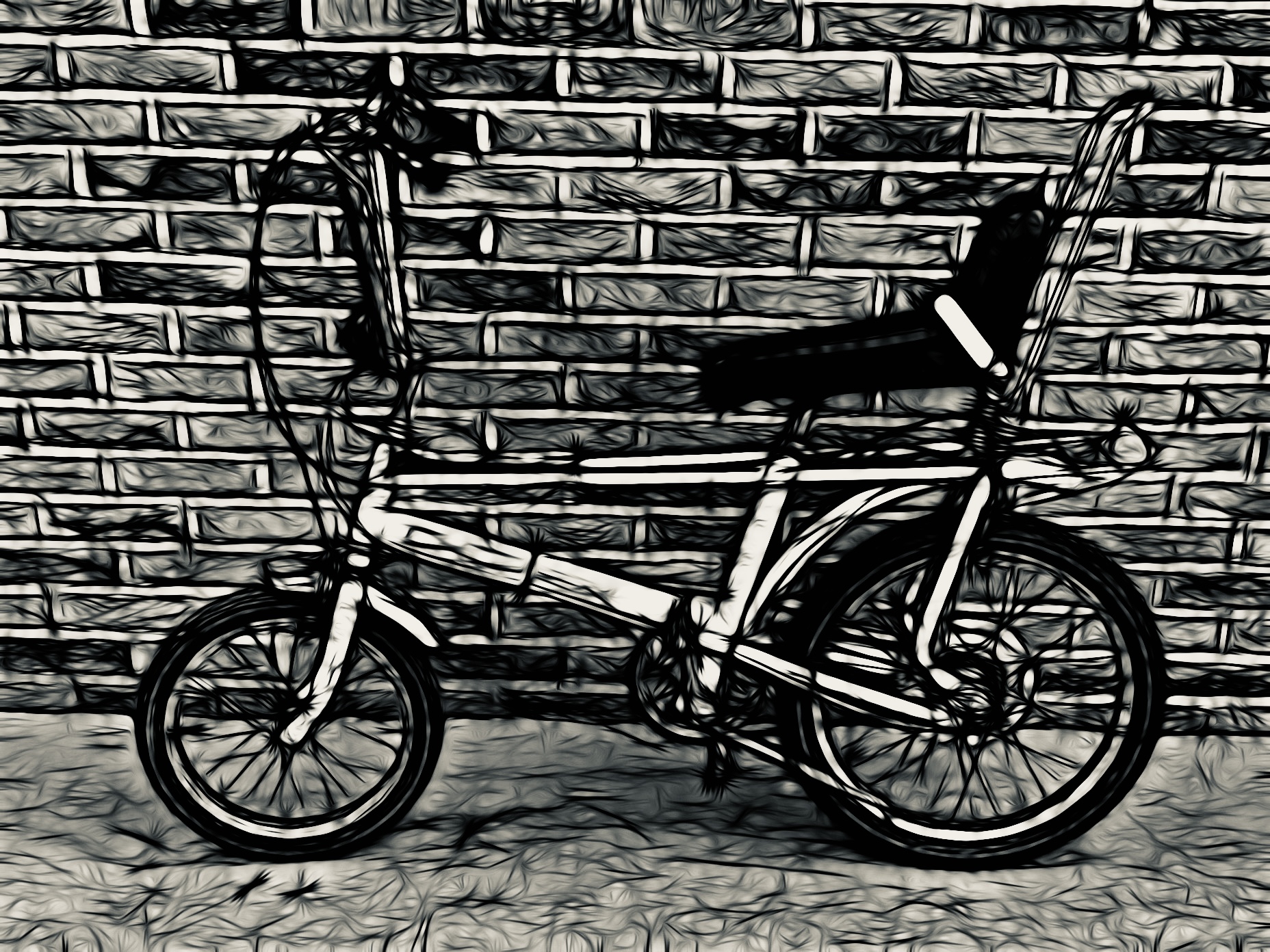
he rode at the back. wheels turning like a ‘45. three gears weren’t enough. the heavy frame of the Chopper didn’t help either. yellow with long slung handlebars and a seat two could fit. he would collect his sister from brownies. her sat behind him as he peddled home. complaints of silver cleaning. there was that one time they had got stopped by the police for riding on the pavement. and for her sat like that. they had got off and walked until the police car was out of sight. then they had enjoyed the speed of the hill. the air through the air. the thrill of doing something risky. the blur of the hedges of houses. the slow stop at the bottom on worn brakes. but now he rode at the back. his friends ahead up the curving hill. cursing the bike as the distance grew. they laughed ahead with calls and the joy of being on an adventure. he wanted to be home. to rest his legs. he wanted a bike like theirs. 10 speed racer with thumb wide frame. large wheels to reduce the need for peddling. he glanced up at the trees that curved down over the road that let in a pattern of light. hints of another world on the road. one of shapes that flicker or gently sway with an occasional dart of black birds. as he reached the big bend, ian was waiting for him. they both gave a knowing smile of best friends and continued together. ian in front, him struggling behind. just as he thought they would be cycling to the heavens, they met the others in a break in the line of trees. a narrow track led into a wood, the path muddy with pools of water. mirrors of a dark canopy. they bumped along. surrounded by the tall netherworld of tree trunks. pine leaf forest of brown and silence. that felt as if they had left the world behind. the world of terraced houses, back garden borders, and too interested neighbours. a world of cars, people and school work. but now they were the four outside the realms of people. the four knights on their stallions, although his was a nag, entering the world of fairies and maidens. until they met a fence. a new wooden fence with a gate. they pushed it open, undeterred and rode on the trail. banks of mud now rearing on either side, topped with small trees and bushes. a turn to the right and they were there. almost hidden but if you knew the secret you could find it. the lake. the lake older than the lady rising with a sword. the lake still with secrets and deep depths. they left their steeds. and sat by the water’s edge. pulling out sandwiches covered in silver foil from their jackets. too happy to say anything. they had reached the fabled prize and were receiving their reward.
a path taken. terraced houses with metal sleeves. yapping dogs at gates mark the boundaries of freedom. a glass jar with string handle swings. what will it be today? a wide open road. not so busy now. the quiet hours. a quick clash and climb down. bridge marking the spot. a trickle of water. pebbles and weed. the sign of a stream. eager eyes look. the quickness of the young defeated. never mind. optimism prevails. darting hands reach and clasp. a tricky customer escapes. aching back pushes another strategy. jar flat in water. waiting. waiting. a lone tiddler edges near. then in. a grab and a swing. the beast captured. weed added for company. the proud hunter climbs up, carefully. follows the path home. trophy held aloof for all to see.
the second hand clicked slowly on crossing the white face of the clock. the black plastic hands told harold it was nearly two. he had been waiting an hour. an hour. and still no news. he sat staring at the blank white door in the blank wall. featureless. no clue there to guide him as to the outcome. no signage for him to lose himself in. if only there were a picture, a painting to pass the time in imagination. he could have lost himself in the colours. the swirl of brush-strokes. the splodges signifying something. a fleeting meaning of a moment, a thought, an idea. but all he had was a white door and worry. why hadn’t she let him go in with her? why the secrecy? what was she hiding? he knew in her way she was trying to protect him but this was worse. the unknowing. all she had said was ‘lady problems’ and left it at that. but that said nothing. she had always been like that. keeping everything to herself. like the time she had her wisdom teeth out. he had known nothing about it until she had come home, had soup for dinner and was barely able to speak. he could have done something. held her hand. said soft words to smooth the pain and fear away. like he had tried with the birth of their daughter. words of encouragement. the damp cloth to the brow. holding of hands, tight, feeling the clench of pain. trying to draw it from her, to will it less. but not this time. not now. today she was alone in that room. without him. maybe he was selfish. maybe he just wanted his fear to go, to be elevated. the pounding in his chest to go down. the hundreds and millions of whispering disasters to die away to nothing. for all to be calm as they sat there. he was probably making a fuss of nothing. he did that. he would imagine a terror where there wasn’t one. he just had to be patient and wait. that was his role: to wait. so he sat and looked at the clock. the white clock on the white wall. it said five past two.
rumble strewn ground. sounds of mortar in the distance. shells stood where homes once were. the carcass of a tank stood in the road surrounded by the fallen. blood patterns on brick and littered bones. he hid behind a wall that once was a building. weren’t they meant to be winning? he remembered the time they had landed. the embrace of the sea. what a sea! he had never seen such blue. the sound of sand beneath boots. the arc of birds across a clear sky. they had marched through green. small villages with friendly locals. an offer of wine and a pat on the back. an easy time. they marched on. over poppy fields, polka dotted landscapes. bees led the way. then the sky darkened. rain began to fall. the sound of distant guns. experience told him they were close. they had entered foolishly. too in the open. he took the route behind rubble, close to the walls. he was no fool. the young fell. first to go was Ajay. three shots to the head and gone. he had liked him. but in war attachments were deadly. better to look after the self. the weapons lay beyond reach. next, was Will running for the tank. he had cried a warning but too late. landmined. a cloud of blood and bone. next Jacob, the leader, taking the high point in a tower with sniper rifle. but they were ready. a trip wire saw to him. so now all alone. crouching behind a wall. bullets hit brick nearby but not there. perhaps it was safe to look. just a second. he got himself ready. moved cautiously and peered around the corner. a crack of a gun. the last thing he saw were the words Squad Killed.
they sat in the cafe at the station. luke warm and weak coffee sat ignored in paper cups. a half-eaten slice of carrot cake waited to be finished.she looked at him, the man she had spent half her life with.the jaw line beginning to go; the flicks of grey over the ears and in a weak moustache. why did he keep it? optimism, she supposed. the only sign he was ever optimistic was wasted on that. he sat in baggy top, to cover a developing paunch, a mark of too many good business lunches, and black baggy jeans. they would have been slim fit once, tight over tight bottom she loved to squeeze. but no more. that too was gone. how had they got so old? she took a tissue and compact mirror from her bag. damped the tissue with the end of her tongue, and gently worked below her eyes to remove smeared mascara. what a sight. she didn’t want to make a scene. even now. that wasn’t like her. perhaps if she had been more forceful in her wants things would have been different. he would have been different. she would have complained about the late nights, the breath that tasted of stale beer, the fumbled sex. she would have demanded care and attention, respect. she would have demanded a child. but those moments were lost in time. ‘no use crying over spilt milk,’ her mother would say. stupid cow. what did she know of struggling? father had given her everything: a house in the suburbs, two holidays a year, her own car. and died. but here she was with her partner sat in a railway station cafe. not even a ring on her finger. in all that time. and now he was leaving. leaving for her.
a room of grey and white walls littered with splodges of colour. different shaped but carefully placed. white chalk splashes on grey softened floor. and the silence of perspiration and concentration. a striped adventurer looks up, rubbing her hand. today blue. an arm stretches up, fingers feeling, testing for the right spot. experience says it can’t be done but that doesn’t deter. she is full of the optimism of this time. a right foot goes up, finds a place, then a push. the other arm stretches, feeling the path, over the holes and bumps until it reaches blue. fingers clasp the hold, left foot, push. a disadvantaged spider clinging to a wall. right hand up. up. come on. just. too. far. a slip. a fall. a soft landing. a smile.








 SLAMFitzsimons