Writing Goals for 2019

So it is a new year and with every new year it is time to set some writing goals for the next 12 months (their like resolutions for writers). So here are mine.

  1. Finish submitting elf book to literary agents. It would be easy for me to let this aspect of writing to slip. I’ve had positive responses but need to follow up and send some more out. It is the process I find most frustrating as it takes so much time to get a response and I want to be pushing forward. A year can go by easily as you wait for replies from agents. And some don’t even use email!
  2. Complete work in progress and a rewrite. This is currently going a bit slow for me. It is mainly due to me: I’m writing out of my comfort zone; I have the most characters I’ve ever dealt with; I’m dealing with a multi-layered plot. This one is hard.
  3. Write lesson plans to go with Wishbone Billy. This is an. idea I’ve had for a while. I have a background of working in schools and I’m sure teachers would be grateful of any materials to make their planning easier. This would also tie in nicely with me offering free school visits.
  4. Complete exciting school visits and visit to Cub Scout group. I have again been invited to schools for World Book Day  this year and also a local Cub Scout group to help them with their book badge. I always love meeting readers and writers, and discussing what excites them. I want to do more!
  5. Not to worry if I don’t complete my goals. Writing books and everything that goes with writing can easily lead you to be overly worried, especially when things are not going well. Writing should be fun and you should not worry if you don’t do everything you set out to do. Keep your cool, take a breath and be happy with what you do get done.

Well, those are my goals for the year. I think they are quite challenging as I can easily get distracted at times from the task in hand. But this year, I’m going to be a new me. (so I lie to myself).

The Writer’s Life

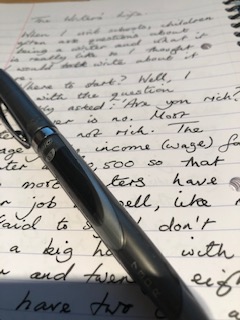
Writing and pen

When I visit schools, children often ask me questions about being a writer and what it is really like so I thought I would attempt to answer some of the most common questions I am asked here.

Are you rich?
The answer is no. Most writers are not rich. The average yearly wages for a writer is £10,500 so that means most writers have another job as well, like me. Unless, you are super succesful like JK Rowling. Then you can write all the time. I’m afraid to say I don’t live in a big house and have twenty-eight cats. I have two and a goldfish.

Are you famous?
No. Very few writers get recognised on the street. The ones that do tend to have been celebrities before they became writers, like David Walliams. They were famous for something else first. Of course, there are a few exceptions like Michael Rosen, Roger McGough or Anthony Horowitz who have also been on TV after their books became well-known. I’ve only been recognised in the street once by a girl whose school I had visited. She yelled, “Look, there’s that writer who came to my school. He’s going into that house!” Otherwise, I walk about never noticed. I could be sat by you and you wouldn’t know.

What do you do when you write? What’s it like?
When I write, I take myself out of the house away from distractions like the TV, cats, fish, reliable internet and go to a place I call ‘the office.’ There I can get endless cups of coffee for just £1.25.
I settle down at the table, look at the outline of my book I’m currently working on, open up my tablet and keyboard and begin writing. I write using a programme called Scrivener which was specially made for writers. While I write, I usually listen to music without voices to cut out any background noise that may distract me and put me off. I might write non-stop for an hour or three. It depends how easily the writing is coming. As I write, I talk to nobody except my characters and imagined audience. They are my only concern.
Writing can be lonely. You sit by yourself, not speaking, not knowing if your writing is any good or worth reading. You just hope it is and carry on. That is why I am also a member of two Writing Groups. There, I share my work, find out what people think of it, if my jokes work, and talk about writing issues such as the best way to solve a problem with point of view.
Sometimes things are different. Sometimes I get to meet my readers when I am invited to a school to do a talk or run writing workshops. Then I get to share my love of writing and talk about books and we do some writing together. It’s great fun.

Have you written any other books?
Yes. Three others but they’re not published yet. One is for grown-ups, one is a kind of Tolkien adventure, and another is about an elf which I’m sending to Literary Agents. I am also working on another one at the moment.

I hope all this helps clear up the things I’m most asked. If you’ve any other questions, just ask in the comment’s box below.

Little Devil In My Ear


There’s a condition that plagues all writers. If you come across a writer of any sort who says they never suffer this then they are a liar. It’s the Little Devil On Your Shoulder that whispers in your ear. Some psychologists call it imposter syndrome and writers may refer to it as writer’s block but I know better. It is an invisible devil that sits there waiting for you to write. Just as pen touches paper it begins it’s games. It tells you You Can’t Write. It laughs Call That A Sentence? It says Everyone Will Think That Rubbish!

My devil still pesters me despite kids secretly reading Wishbone Billy at night or having 5 star reviews on Amazon or receiving positive responses from my author visits. That devilish negative voice can be so loud. It stops you from writing anything. You procrastinate: watch junk TV, tidy the house, daydream. The pen lies still.

I am not the only writer to suffer the devil. Vivian Gornick, critic and journalist says of it: I would look at the words on the page – still do – and think, ‘This is so naive. This is so stupid. Who’s going to want to read this?’ It was even said of the brilliant Scott Fitzgerald of Great Gatsby fame that he fell into the devil’s hands after an estatic review from Gilbert Seldes. Poor Fitzgerald, after that every word had to be brilliant, every work deserving of high praise.

The devil by the ear attacks children too. I see it every day. It tells them they can’t write. It laughs at their efforts. Their page remains  empty. Their teacher grows impatient. What can be done? We must fight against the devil together.

Pick up that pen. Strike a blow to the devil’s head. Tie it up with adjectives, smother it in similes, drown it in metaphor. Let your pen roam free. It doesn’t matter what you write. It can be as sensible or silly as you want. You can write. You’ve been writing since your first crayon marks in nursery. Each word deserves an ovation. That devil knows nothing. Kick it away!

This piece of writing waas brought to you care of one squashed devil.


Writing Spaces


Tangled FX 2.1 (4 May 2018, 11:34:49) Swirls preset

Most writers have a favourite writing space where they like to write and I am no exception.  It is a place where we find it easier to switch into writing mode and concentrate  on the worlds we are creating. They are part of our routine and without them we can writing frustrating, full of distractions, a basic non-starter.

Where writers choose to write can be varied depending on finances, personality or necessity. Stephen King, the famous horror writer, in the early days of his career found himself strapped for cash and the only place he could go to was the cramped laundry room of his house next to the washing machine. Perhaps it was the whine of the spin cycle that helped him produce his book Carrie.

Mark Twain, the writer of children’s classic The Adventures of Huckleberry Finn, didn’t have that problem due to the fame and fortune his books brought him. He had a private study built away from his house in the garden where he used to go after a good breakfast to write during the day. If he was wanted by his family, they would blow a horn to fetch him. I can just dream of having such a writing place.

Roald Dahl, the writer of so many great children’s book (and my favourite kid’s author) was more modest in his writing space. He used a shed in his garden with a favourite armchair and a space littered with objects to inspire.

Charles Dickens also had favoured pieces of furniture: a desk and chair. It was so important to his writing that he would often get it shipped with him if he was going to be away from his home for a while.

I don’t have the garden size or finances for a shed or study but do have a ‘work room’ where I have a computer desk and swivel chair. This was where I typed up Wishbone Billy from my notes every evening in 2012 but it wasn’t where I created the first draft. Here, is where JK Rowling and I are similar. Her early drafts of Harry Potter were written in a cafe, for, as she put it, ‘You don’t have to make your own coffee, and you don’t have to feel like you’re in solitary confinement.’

I equally have to be with an easy supply of coffee and the gentle bustle of people as they come in and out of the pub I work in. I sit at my favourite table, slightly apart from the main part of the pub, under dim lights, with free coffee refills aplenty tapping away on my Bluetooth keyboard connected to my iPad mini whilst listening to the gentle notes of The Poet by Bruno Sanfilippo  (my go to writing music that always gets me in the zone). It is my writing place as I’m away from the distraction of daytime TV or easy access to the Internet – the internet at the pub is quirky at best so stops me from going down the wormhole of Twitter. Besides, it has the bonus that I can reward myself with a pint after a few productive hours of writing.

What’s your writing space?

Becoming A Time Lord


Lately, I have been spending a lot of my energy attempting to be a Lord of Time and, like any possible Timelord, I have been getting to grips with time and their relative dimensions in space. Now, you might think this is a quite straight forward thing to do as a writer but you would be wrong.

1)TIME is always the BIGGEST problem. You may have a job, family (particularly the young lively sort), pets, clubs, homework or household chores that always seem to demand your attention at the moment you settle down to write. It is very difficult to get to write with any or many of these in your life. Some may call these excuses but I challenge them to write anything with a three year old vomiting on their pencil. So, like myself, you may find it better not to schedule a particular time but rather take advantage of the odd 1/2 hour – hour that may arise throughout the day. Instead of watching that TV, reading a magazine  or book (yes, I did say that), write. Being a Timelord demands sacrifice.
Even snippets of 5 or 10 minutes can be effectively used. Not for writing great reams but for imagining, asking what ifs, or as I have recently done, to jot down a key piece of exposition that you may forget.

2)RELATIVE – best avoided. They tend to take over your life when they visit or fill your imaginative quiet with noise. At worst, they are vocal critics. If you get yourself a useful, trained one, they might be of use as a cheap editor.

3)DIMENSIONS can be important. You are probably best going for ample room for paper, pen, laptop/tablet (if needed). Most important, leave plenty of room for snacks and coffee. Sacrifice personal comfort if necessary for the sake of coffee. It is the fuel that drives a Lord of Time. With enough, you will become transcendental in your writing and won’t notice the cramped space in the cupboard you are working in. If space is at a premium, I suggest something stronger than coffee.

4)SPACE can be a problem. Unless you are extremely well paid or fortunate to live in a relatively empty house, finding a quiet place to lock yourself away can be a problem. Sometimes you just have to make do even if it is a breakfast encrusted dinner table or on an unmade bed or in a cafe or on the back of the trained relative. A useful tactic is to choose a location without a tv or wifi, or if this isn’t possible, one with an annoyingly poor connection that makes you go through ridiculous procedural form filling to get just 2 minutes online. You will then soon no longer be tempted by such diversions. Remember, being a Timelord demands sacrifice.

So there you have my secrets of becoming a Timelord and going onto future success at getting something down on paper (using the toilet doesn’t count).

LITTY STUFF: Originating Orphans

Writers' Workshop

I recently was lucky enough to attend a workshop on How to Write Kids’ Fiction led by Joe Craig and Anthony McGowan as part of the Wood Green Literary Festival organised by the Big Green Bookshop. We were also fortunate enough to have Marianne Levy and Allan Boroughs (whose first book will be out next year) in the audience so there was a very good ratio of the published and would be published.
It was a very refreshing experience hearing from two writers of very different fiction. What came across was their thorough understanding of the genre they work in and enthusiasm for each other’s work as well as those trying to break through. What was of particular interest to me were their theories concerning structuring a narrative with an interesting protagonist – I guess it’s a hark back to the days when I studied Literature.
One of the points from Anthony McGowan that particularly intrigued me was the concept that the main character needs to be an orphan in some way. This is because parents or responsible adults would stop the protagonist from doing what they need to do. The orphan becomes a wanderer on their journey, receiving gifts from helpers on route. Eventually, there is a climatic battle before the end resulting in the orphan becoming a martyr somehow (my notes on this last bit aren’t great).
It struck me, that this is essentially what I did with my character Billy in my first book without realising it and got me wondering how many different ways a character can be an orphan. Here’s my list so far:

  • The character is an actual orphan (BFG;Harry Potter; A Series of Unfortunate Events;Walkabout)
  • The character is emotionally isolated from parents (Matilda;Goodnight Mr Tom; I Will Call It Georgie’s Blues)
  • The parent becomes lost/absent (Pippi Longstocking; Nim’s Island;Famous Five books)
  • The child is isolated due to a disagreement (The London Eye Mystery)
  • The child is isolated due to a secret (The Borrowers; The Magic Finger; The Turbulent Term of Tyke Tyler)
  • The child is isolated due to a physical/mental condition (Secret Garden; The Curious Incident of the Dog in the Nightime; Henry Tumour)
  • The child is lost 
  • The child is economically lost (Charlie & the Chocolate Factory)
  • The child is isolated due to social mores
  • The child is isolated due to a need to enact a rescue or go on a journey (Lion, Witch & Wardrobe; The Ice Palace)

There are probably many more but I can’t think of them for the moment or of examples to go with a couple of my ideas. Perhaps you could suggest some.

I did some background reading on the orphan concept using Wikipedia  and a study by Kimball . If anyone can suggest a source for a more contemporary take on this, I would be grateful.

Cheers

silence

silence

a single tear
white and crystalline
clings to the surface
making blue cold
still
a forest of alabaster
stands silent
almost unmoving
as air whispers dance
speaking of tales
of dead adventurers
from distant lands
stuck in time
compass frozen
before scurrying on
who will sing
a song for them now
the great polar spirit
cries alone
before leaping after
its bearded flesh

SILENCE This poem stemmed from me playing with a random word generator. I knew I wanted to write a “still” poem about the arctic but just need a few words to trigger a start even if I didn’t use them in the actual poem (which I didn’t).