Pulling A Blank


22504F9C-90B1-4611-B70F-22C901E5A62C.jpeg

You will have noticed I haven’t written an entry for my blog for a while. There is no great mystery behind it. I was not kidnapped, transported to another planet or plummeted into a mystical realm like the children of Narnia. No. It is quite simple. I was going through what many writers go through at various points when writing: writer’s block.  I just couldn’t think of anything to write for my blog.

Maybe it was because my creative energies were being sapped by two other things: submitting my second book to Literary Agents (time consuming and somewhat soul destroying) and compiling the notes on my third book before settling down to editing proper. I’m still at both of these and they have become my obsessions.

This meant I had less time to just let my wander and play in the quiet moments. This is an essential part of writing. If you are told to ‘just write,’ often you’re mind goes immediately blank.

That’s why writing at school can be really hard. The blank page and your teacher asking you to come out with some great story just like that. And there are all the things you are told to remember: fronted adverbials, alliteration for effect, a simile or metaphor or two. No wonder you mind just freezes. How can anyone write under such pressure?

Take a moment and put your pencil down. Stare out the window. Watch the trees in the breeze, traffic passing or the rain fall. Take some calming breaths. Think about what you are interested in: A TV programme you watched; a computer game you play; a song you like; a pet you cuddle… Make that your story.

There are no rules when writing stories. You can have happen whatever you want. You are the magical master. If you want a tap-dancing zebra as a class teacher, so be it! You want to be skiing on the skin of a bowl of custard, go on! It is your world. Rule it.

The Writer’s Life

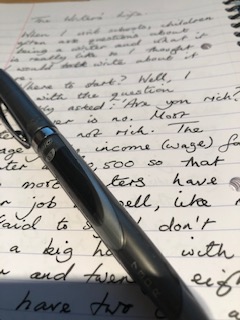
Writing and pen

When I visit schools, children often ask me questions about being a writer and what it is really like so I thought I would attempt to answer some of the most common questions I am asked here.

Are you rich?
The answer is no. Most writers are not rich. The average yearly wages for a writer is £10,500 so that means most writers have another job as well, like me. Unless, you are super succesful like JK Rowling. Then you can write all the time. I’m afraid to say I don’t live in a big house and have twenty-eight cats. I have two and a goldfish.

Are you famous?
No. Very few writers get recognised on the street. The ones that do tend to have been celebrities before they became writers, like David Walliams. They were famous for something else first. Of course, there are a few exceptions like Michael Rosen, Roger McGough or Anthony Horowitz who have also been on TV after their books became well-known. I’ve only been recognised in the street once by a girl whose school I had visited. She yelled, “Look, there’s that writer who came to my school. He’s going into that house!” Otherwise, I walk about never noticed. I could be sat by you and you wouldn’t know.

What do you do when you write? What’s it like?
When I write, I take myself out of the house away from distractions like the TV, cats, fish, reliable internet and go to a place I call ‘the office.’ There I can get endless cups of coffee for just £1.25.
I settle down at the table, look at the outline of my book I’m currently working on, open up my tablet and keyboard and begin writing. I write using a programme called Scrivener which was specially made for writers. While I write, I usually listen to music without voices to cut out any background noise that may distract me and put me off. I might write non-stop for an hour or three. It depends how easily the writing is coming. As I write, I talk to nobody except my characters and imagined audience. They are my only concern.
Writing can be lonely. You sit by yourself, not speaking, not knowing if your writing is any good or worth reading. You just hope it is and carry on. That is why I am also a member of two Writing Groups. There, I share my work, find out what people think of it, if my jokes work, and talk about writing issues such as the best way to solve a problem with point of view.
Sometimes things are different. Sometimes I get to meet my readers when I am invited to a school to do a talk or run writing workshops. Then I get to share my love of writing and talk about books and we do some writing together. It’s great fun.

Have you written any other books?
Yes. Three others but they’re not published yet. One is for grown-ups, one is a kind of Tolkien adventure, and another is about an elf which I’m sending to Literary Agents. I am also working on another one at the moment.

I hope all this helps clear up the things I’m most asked. If you’ve any other questions, just ask in the comment’s box below.

Writing Spaces


Tangled FX 2.1 (4 May 2018, 11:34:49) Swirls preset

Most writers have a favourite writing space where they like to write and I am no exception.  It is a place where we find it easier to switch into writing mode and concentrate  on the worlds we are creating. They are part of our routine and without them we can writing frustrating, full of distractions, a basic non-starter.

Where writers choose to write can be varied depending on finances, personality or necessity. Stephen King, the famous horror writer, in the early days of his career found himself strapped for cash and the only place he could go to was the cramped laundry room of his house next to the washing machine. Perhaps it was the whine of the spin cycle that helped him produce his book Carrie.

Mark Twain, the writer of children’s classic The Adventures of Huckleberry Finn, didn’t have that problem due to the fame and fortune his books brought him. He had a private study built away from his house in the garden where he used to go after a good breakfast to write during the day. If he was wanted by his family, they would blow a horn to fetch him. I can just dream of having such a writing place.

Roald Dahl, the writer of so many great children’s book (and my favourite kid’s author) was more modest in his writing space. He used a shed in his garden with a favourite armchair and a space littered with objects to inspire.

Charles Dickens also had favoured pieces of furniture: a desk and chair. It was so important to his writing that he would often get it shipped with him if he was going to be away from his home for a while.

I don’t have the garden size or finances for a shed or study but do have a ‘work room’ where I have a computer desk and swivel chair. This was where I typed up Wishbone Billy from my notes every evening in 2012 but it wasn’t where I created the first draft. Here, is where JK Rowling and I are similar. Her early drafts of Harry Potter were written in a cafe, for, as she put it, ‘You don’t have to make your own coffee, and you don’t have to feel like you’re in solitary confinement.’

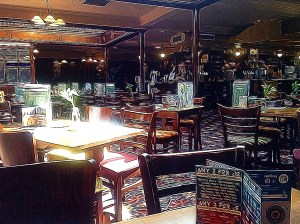
I equally have to be with an easy supply of coffee and the gentle bustle of people as they come in and out of the pub I work in. I sit at my favourite table, slightly apart from the main part of the pub, under dim lights, with free coffee refills aplenty tapping away on my Bluetooth keyboard connected to my iPad mini whilst listening to the gentle notes of The Poet by Bruno Sanfilippo  (my go to writing music that always gets me in the zone). It is my writing place as I’m away from the distraction of daytime TV or easy access to the Internet – the internet at the pub is quirky at best so stops me from going down the wormhole of Twitter. Besides, it has the bonus that I can reward myself with a pint after a few productive hours of writing.

What’s your writing space?