2022 and all that

Well, 2022 brought a number of changes which impacted on what I write here. I have been submitting a new novel for consideration. But primarily, I have been writing a lot of prose-poetry. This has led me to the new outlet for my writing of Spoken Word.

What is Spoken Word?

Spoken word is when you perform any piece of writing to a group of people. It is often poetry but can be a story, monologue, or something else. It is quite flexible as to format.

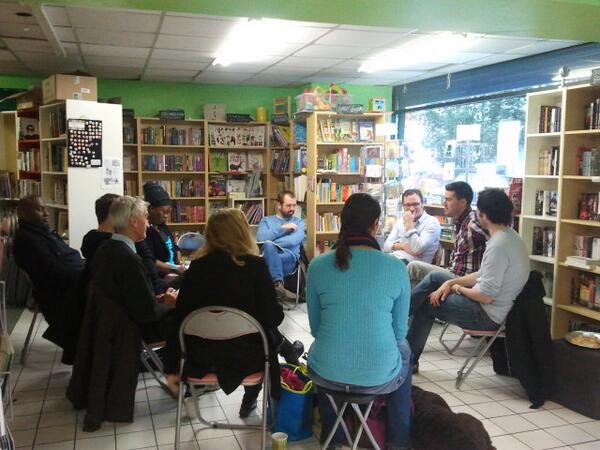
Due to writing a lot of prose-poetry and sharing at my favourite writing group, I was encouraged to attend a Spoken Word night. I went along, sat, watched, then thought: I want to set up one of those. And where better than my favourite bookshop in my local area. So far they have been going well and I have been exposed to some great fresh writing that excites me and always leaves me thinking. Such a variety is on offer. All unique voices that should be heard.

Children love Spoken Word and enjoy writing poetry so it is a great thing to do for World Book Week. Why not start by enjoying watching some Michael Rosen, Benjamin Zephaniah, John Hegley, Kate Tempest, or Anthony Joseph?

As well as Spoken Word, I have been plotting and writing another one. I have changed my approach and audience for it. I’m venturing somewhere new. It is challenging and exciting. I’m trying to apply some of the approaches I use for my prose-poetry to the novel writing. I’m not sure it will work. Only time can tell.

What have you been doing?

Moment

There is that sweet moment of the day when silence seems to descend and time holds still and even the bustle of a packed café remains unnoticed as you let your mind wander, take a turn down a path, untrodden, overgrown with branches forming a canopy of green, and as you wander you begin to notice the magical figures that flitter between the leaves, darting from flower to flower to add a sparkle of colour, and just ahead you glimpse a white steed, a unicorn, drinking from a brook as an elf plays a lullaby on a panpipe, an it is at these moments you paint a scene, craft a character and place them, give them words to say and a task to do, a quest to strive after, to reach for like the words you seek to place on a page, a phrase of imagination, and then you pause for a moment, look around, and realise where you are, in that café, surrounded by people.

This came about when wondering what to write. It had been a while since I wrote something new as I had been spending my time editing a book of mine ready for submission so the creative muscle was rusty. And whilst sat there in the open with a coffee nearby, it reminded me of all those times when time stood still as I wrote, how it could take you places and how a good piece of writing could also take its reader places. So I wrote about that moment.

LITTY STUFF: Originating Orphans

Writers' Workshop

I recently was lucky enough to attend a workshop on How to Write Kids’ Fiction led by Joe Craig and Anthony McGowan as part of the Wood Green Literary Festival organised by the Big Green Bookshop. We were also fortunate enough to have Marianne Levy and Allan Boroughs (whose first book will be out next year) in the audience so there was a very good ratio of the published and would be published.
It was a very refreshing experience hearing from two writers of very different fiction. What came across was their thorough understanding of the genre they work in and enthusiasm for each other’s work as well as those trying to break through. What was of particular interest to me were their theories concerning structuring a narrative with an interesting protagonist – I guess it’s a hark back to the days when I studied Literature.
One of the points from Anthony McGowan that particularly intrigued me was the concept that the main character needs to be an orphan in some way. This is because parents or responsible adults would stop the protagonist from doing what they need to do. The orphan becomes a wanderer on their journey, receiving gifts from helpers on route. Eventually, there is a climatic battle before the end resulting in the orphan becoming a martyr somehow (my notes on this last bit aren’t great).
It struck me, that this is essentially what I did with my character Billy in my first book without realising it and got me wondering how many different ways a character can be an orphan. Here’s my list so far:

  • The character is an actual orphan (BFG;Harry Potter; A Series of Unfortunate Events;Walkabout)
  • The character is emotionally isolated from parents (Matilda;Goodnight Mr Tom; I Will Call It Georgie’s Blues)
  • The parent becomes lost/absent (Pippi Longstocking; Nim’s Island;Famous Five books)
  • The child is isolated due to a disagreement (The London Eye Mystery)
  • The child is isolated due to a secret (The Borrowers; The Magic Finger; The Turbulent Term of Tyke Tyler)
  • The child is isolated due to a physical/mental condition (Secret Garden; The Curious Incident of the Dog in the Nightime; Henry Tumour)
  • The child is lost 
  • The child is economically lost (Charlie & the Chocolate Factory)
  • The child is isolated due to social mores
  • The child is isolated due to a need to enact a rescue or go on a journey (Lion, Witch & Wardrobe; The Ice Palace)

There are probably many more but I can’t think of them for the moment or of examples to go with a couple of my ideas. Perhaps you could suggest some.

I did some background reading on the orphan concept using Wikipedia  and a study by Kimball . If anyone can suggest a source for a more contemporary take on this, I would be grateful.

Cheers