divided worlds

there is separation that exists in all writing. the writer knows it is there. tries to ignore. pretend it doesn’t exist never existed shouldn’t exist must not exist does not deserve to exist but nevertheless persists in its existence. it hangs there. on the edge. like a small snag of fingernail that catches on a jumper as you pull it on and with a sudden sharp pain makes you aware.

a writer sets out when writing a piece in a belief a commitment a fallacy that what they imagine to be what they can imagine to be will come to be. will exist. once they have put pen to paper. drafted. edited. rewritten. checked. line-edited. drafted again. but it is not there. the thing they imagined does not exist. their writing cannot not create it. even if they were to train a million apes brought up on shakespeare how to type and gave them their work to work on for a million years the problem wouldn’t be solved. the final draft would exist but be lacking. would have a distance between the imagined and the reality of the word.

this distance is what writers have to live with. each time they put pen to page. make their plans. start to write. they know they will not achieve the story they set out to do. that there will be a piece lacking. a slither where their skill was just not enough. but they lie to themselves that this time it will be different this time they will be better and sometimes they are and this time they will put their all to it and pull each and every imaginative writing sinew to the creation of their work. but they know they tell themselves a lie. that it is a lie to get them started. else they would never begin or go mad during the writing process.

that is why all writers are great liars. they tell themselves most fundamental untruth to themselves and their reader. they see this is what i had planned this is what i intended now buy my perfect book. but we know this to be untrue. and the reader and writer join in with this lie. form a bond in untruth. until the next time.

doppelganger

Minimalist portraiture women outdoors

Margaret Atwood in her book ‘On Writers and Writing’ talks of authors living in a life of split-personality. Like Dr Jekyll and Mr Hyde we exist with a darker self, our writer’s voice or being. Whilst we live good wholesome lives earning a crust to support our writing identity and enable us to do the thing we love, when faced with a blank page and a typewriter we turn dark. We will happily murder a character that our poor readers have grown to respect and love. We will with joy bestow upon a poor child a life of misery in the harshest of conditions with no seemingly way to exist the torment. We will bring death to the door of a beloved pet. All for the story. Always to the unseen god of story.

It is no wonder then that some readers when faced with the writer in front of them may confuse the voice of the book, the one they had previously trusted until the heroine died horribly in a fire, is the same as the voice of the writer. That both hold the same sentimentalities and beliefs. That both are not indistinguishable from the other. After all, are not writers told to ‘write what you know?’ What more evidence is needed then that the writer is capable of these hideous offensives?

Yet, when writing the writer often detaches themselves from their character and world. Yes, there may be elements of their psyche that influences the path of the story. But the story is a being onto itself. The characters make demands. Choose their own paths. You may hope a character will do certain actions but the god of story may demand otherwise. And who is brave enough to oppose the god of story? Those who do sacrifice their existence.

words

White paper on black background

i’ve always had a problem with words. not the deciding on them. not the thinking of them. the focusing on the words to use. the need to reach for a thesaurus because they just won’t come. not that problem. the word count. that’s the issue. no matter how big an idea or how many chapters i seem to always get a low word count.

i plan out my writing. brief lines with a few details what will happen in each chapter. then i begin and write. i sit down at my keyboard and tap away. the idea clear in my mind. full knowledge of the setting and what the character has to achieve in that chapter. i write the scene. describe the setting, add the action and dialogue. build it up as slow as i can. chapter finished. 1500-2000 words. where’s the rest of it? surely i can write longer?

being a two finger typist, i think: maybe its the typing. maybe i should revert back to the old pen and paper. ditch the modern technology. unhamper myself. free myself to write without the distractions a machine brings. but it’s no good. still the same length of chapter. 1500-2000 words. still the problem that the novel is just not long enough for publishers.

perhaps it goes back to me. i’ve never been one to talk lots. always one to listen. speak when i have something to say. something to share. my shaggy dog stories peter out. the dog dies before it gets to the end of the tale. conciseness is in my nature. why use 300 words when a sentence will do? there are some who can talk. really talk. add lots of detail and atmosphere. and write that way. but my thinking has always been why mention the table is red if the colour isn’t important? only mention the details that are important to the plot and events. cut back the chaff.

perhaps my whole approach is wrong. maybe i need to let forth with a wave of unnecessary words. use 100 when 10 would do. but it goes against my grain. perhaps, as i suspect, it is the demanded word counts are wrong that a novel should be the length it should be. should the ‘great gatsby’ be made longer because it doesn’t meet acceptable word counts? max porter’s work lengthened to an epic? or do the publishers need to be more flexible in their approach? is it time for change? perhaps selfish i know. me calling for a revolution just to suit how i write. but think of all the great writing lost because it didn’t meet a required format (i don’t include myself in this).

words. when are many too many? few too few?

in praise of the futile

a lot of my time recently has revolved around the issue of copyright and ai. if you’re wondering, i’m against allowing big tech to scrape the work of creatives to train ai without permission. it is theft plain and simple.

there are some who confuse having an idea with creativity. they mistakingly think it is the idea that trumps all. they disregard that creativity is a process. it is the process of flinging an idea into the open, developing it, refining it, abandoning parts, developing others. it is not the click of a button to generate a text or image or song. there is no human process there.

ai will never become creativity or be creative. ai solely seeks a quick fix profit. there will always be a profit margin for ai generated ideas. it will never explore the futile. the time spent on a creation that may not go anywhere. may not sell. is created just for the process and the act of creation. where there is no profit.

humans do not just create for profit. they create to experience a fuller understanding of their imaginative soul. to explore the connection between the sub-conscious and conscious. to play between the cracks. a flick of a button denies that. denies the fulfilment of the creative soul. the human needs to do the futile. to do something just because. it is what leads to advances and revelation. not the regurgitation of what has been.

embrace your futile self while you can. demand the right to be futile. to create without success or reward. to be human.

paper vomit

i always struggle with writing. i battle to put words on the page. splatter them on the whiteness. i guess it’s the combination of anxiety and the need for perfection. i worry if the words are not perfect. i physically need them to be perfect. heart beating. mind racing. hands tense.

if they’re not perfect i can’t move on. i can’t write another word. all i can think about is the imperfection. there is something wrong and i need to fix it. even if i can’t identify the flaw there is something that knows it is there. that it requires refining. tearing up and doing again. a single thousand word chapter can take me anything from two weeks to three months. before exhausted by the battle i move on. slow. glancing back at the previous words. the ugly.

i know the first draft is meant to be vomit on the page. i have read it said by wiser and more successful writers than i. just get it down. the edit will fix it. it is what the edit is for. the redraft. the first draft is just for getting the story down. it is only when it is finished you know what your story is really about. where to go next.

i guess it stems from childhood this affliction. my schooling. being told to get my story done ready to present to the teacher and the red pen. it had be perfect first time. we only had one shot at it. later, the schools recognise some redrafting had to be done. so it became a pattern of first draft, edit, final draft. but still that wasn’t enough time. the teacher still had a red pen. and there still were flaws. cracks in the works. why didn’t they allow more time?

i think it was to be kind to us. not to delusion us. writing is bloody hard. it takes hours of toil in a room with a blank page. battling to choose the right words. craft the story. create realistic characters that really speak. not recite. hour upon hour spent on getting it right. only for it to be finally ignored. left unread by our intended audience. who would let children see that? experience that? better to leave them with the dream that putting words to a page was possible by all. without that lie where would our writers come from?

hemingway

i first came across hemingway when doing a course on writing at citylit, london. if you don’t know citylit, it’s an adult learning college locate near holborn tube. that big long road that winds it way down pass theatres and hotels to waterloo bridge and the south bank. citylit runs many creative courses and i heard good things about its writing courses and heard they were doable if on a budget. i’m always on a budget.

the courses are often taught by stabilised writers. this one was taught by scott bradfield. we were often set things to read. and he set us the short story ‘hills like white elephants’ to read. i read it. read it again. it was like a revelation to me. here was a writer cutting out loads of description, reams of adjectives and adverbs, to pare back the story to its essence. the writing was like a fresh of air. a chill winter wind that wakes you from a night of over indulgence. it was like hemingway was giving me permission to do something. something i had long thought.

i had studied literature as part of my ba. a diet of hardy, dh lawrence, and george eliot (oh god, george eliot). they loved their long winding descriptions where a hundred words were better than five. long rolling descriptions of the scenery. adjective upon adjective that wound their way across the pages before a character did something. followed by exposition. how they loved exposition.

i followed this by teaching primary and mainly reading children’s literature. children’s literature loved an adverb and adjective. not forgetting a liberal use of simile and as many words for ‘said’ you could think of. so did the national curriculum. this is what they decided good writing consisted of. no hemingway style for them. you had to use lots of adverbs and adjectives to tick the boxes. not forgetting the whole range of punctuation.

it is not surprising then that this is what i thought writing was. had to be. i had been fed a diet of word types. all the word types. used liberally and often. yet i was not satisfied. why did we have to mention all the senses? in every description? surely, you should focus on the important ones for that scene? and did we really need long passages of description to describe a setting whilst the character was left in limbo? doing nothing. waiting for us to finish. my thinking was we should treat the setting as a character. and f important to the plot. then we spent time on it. but if passing through. was there a need? i began to have doubts over the way writing was taught and the way i wrote.

so reading hemingway gave me approval of my ideas. to leave the adverbs behind. use adjectives sparingly. use five words instead of a hundred. cut writing to the bone. to the essential. to what i considered important. gone were adverbs. i went further. reducing articles. conjunctives. pairing back the range of punctuation. the length of a sentence. reducing the sentence to its minimum. to the minimal point at which it could still be understood.

my prose-poetry is a concentrated version of that. my short stories and the novel i’m working on. less so. grammarly would have a system failure reading those. and i continue to experiment. wonder how further i should push it. the results are here on this website. see what you think.

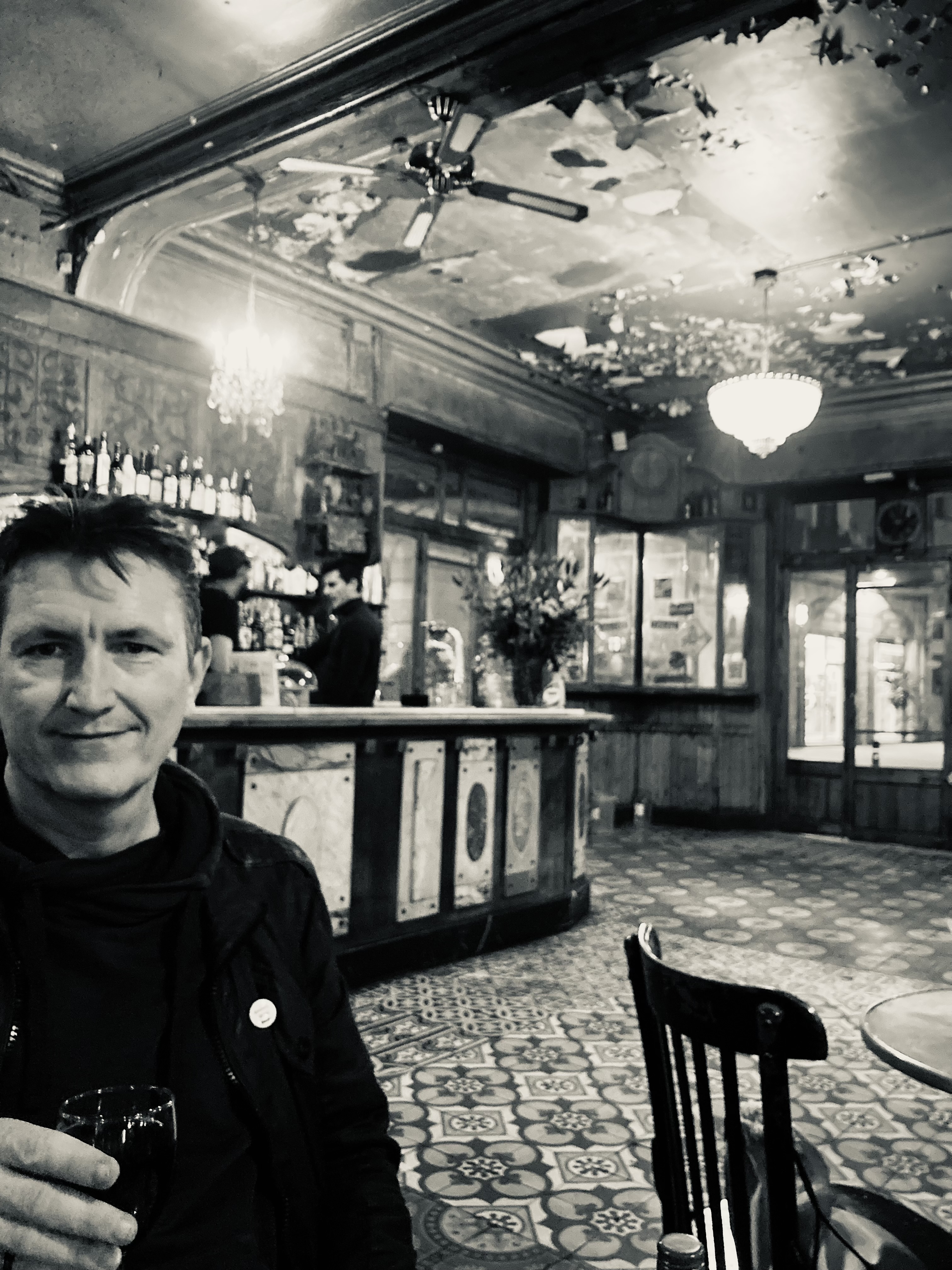
the photo? the significance of the photo? that’s me in a bar in barcelona that hemingway was meant to frequent. it was meant to have changed little since his time. unlike the bar. i think hemingway has changed writing forever.

stuff about writing

Image of cup with writing on it. Prose poem writing.

So I have been reading ‘Swallowed by a Whale’ which is a book all about writing by writers and I have come to a few conclusions about writing.


1) Write. You should write. There is no avoiding it. Even if you dislike it. You have to write to become a writer. Many say each day. Or regularly. The amount of time does not matter or the word count. The important thing is to do some writing. Not to put it off. Procrastinate. Clean the tiles in the kitchen with a toothbrush. After all, that blank page will not fill itself.

2) Thinking counts as writing. Daydreaming counts as writing. Going for a walk daydreaming about thinking about writing counts as writing. It is important to do. It solves writing problems. It gives your mind space to create. No need to ask permission. Just do it. I find walking somewhere or sitting in a pub always works for me. Try it.

3) Adverbs are out. And adjectives as well. Exclamation marks for some reason! I have no idea why. They just say they are. Words will be next. You have been warned.

4) Where you write doesn’t matter. At a table. On the tube. In a specially constructed hut with all your nice things that someone else paid for (I wish). I tend to write in pubs. I find if I am away from household things I’m not feeling guilty about the things I haven’t done. I can give myself permission to write. When I’m in the house and writing I feel neglectful.

5) Get your first draft down and don’t worry too much about errors. Do not start rewriting your first few chapters over and over again as much of it will be cut. Mind you, I don’t follow that rule at the moment. I am writing a chapter, taking an enforced break, re-writing that chapter, write a new one. I find it gets me back in to writing as I can’t always write every day. It continues my flow and allows me to think of ideas to add to a chapter and act on it within a short time frame. I’m no good at making novel writing notes. Mine would be too brief so completely incomprehensible when going back to a chapter. Or so detailed, they would take longer than the novel. My approach works for me. It may work for you. Try it. Think about. Then do it your way.

6) Do not compare yourself to other writers or try to be another writer. You can’t. You can only be you. Their books you read have had a lot of time spent on so your first draft won’t be like that. And their lived experience makes them what they are and how they write. If you try to copy, it will be a pale imitation. Write you. Do not worry about other writers’ success. Think about your own triumphs. Set yourself small manageable goals. It is the nature of writing that you will never be happy with what you have achieved. Sorry. But we are riddled with self doubt. Even great writers like Dickens thought their writing might not be up to scratch.

7) Do not read reviews. Positive ones will only enlarge the ego and make you think you are a master of your craft and don’t need to improve. This leads to stagnation. Or you will think you are terrible and stay awake every night thinking about them. Just be happy if someone buys your book. If only just once. Someone liked the idea. You.

9) If you’re writing you are a writer. No one says to an unexhibited artist they’re not an artist or unrecorded musician they are not a musician. If you create you are a creator. You don’t need permission or official recognition to be a writer. Are you writing? Then you’re a writer. It’s that simple.

10) Writers like lists. They’re quick to write.

Thoughts based on Swallowed by A Whale (How to survive the writing life),’Edited by Huw Lewis-Jones.

2022 and all that

Well, 2022 brought a number of changes which impacted on what I write here. I have been submitting a new novel for consideration. But primarily, I have been writing a lot of prose-poetry. This has led me to the new outlet for my writing of Spoken Word.

What is Spoken Word?

Spoken word is when you perform any piece of writing to a group of people. It is often poetry but can be a story, monologue, or something else. It is quite flexible as to format.

Due to writing a lot of prose-poetry and sharing at my favourite writing group, I was encouraged to attend a Spoken Word night. I went along, sat, watched, then thought: I want to set up one of those. And where better than my favourite bookshop in my local area. So far they have been going well and I have been exposed to some great fresh writing that excites me and always leaves me thinking. Such a variety is on offer. All unique voices that should be heard.

Children love Spoken Word and enjoy writing poetry so it is a great thing to do for World Book Week. Why not start by enjoying watching some Michael Rosen, Benjamin Zephaniah, John Hegley, Kate Tempest, or Anthony Joseph?

As well as Spoken Word, I have been plotting and writing another one. I have changed my approach and audience for it. I’m venturing somewhere new. It is challenging and exciting. I’m trying to apply some of the approaches I use for my prose-poetry to the novel writing. I’m not sure it will work. Only time can tell.

What have you been doing?

Moment

There is that sweet moment of the day when silence seems to descend and time holds still and even the bustle of a packed café remains unnoticed as you let your mind wander, take a turn down a path, untrodden, overgrown with branches forming a canopy of green, and as you wander you begin to notice the magical figures that flitter between the leaves, darting from flower to flower to add a sparkle of colour, and just ahead you glimpse a white steed, a unicorn, drinking from a brook as an elf plays a lullaby on a panpipe, an it is at these moments you paint a scene, craft a character and place them, give them words to say and a task to do, a quest to strive after, to reach for like the words you seek to place on a page, a phrase of imagination, and then you pause for a moment, look around, and realise where you are, in that café, surrounded by people.

This came about when wondering what to write. It had been a while since I wrote something new as I had been spending my time editing a book of mine ready for submission so the creative muscle was rusty. And whilst sat there in the open with a coffee nearby, it reminded me of all those times when time stood still as I wrote, how it could take you places and how a good piece of writing could also take its reader places. So I wrote about that moment.

LITTY STUFF: Originating Orphans

Writers' Workshop

I recently was lucky enough to attend a workshop on How to Write Kids’ Fiction led by Joe Craig and Anthony McGowan as part of the Wood Green Literary Festival organised by the Big Green Bookshop. We were also fortunate enough to have Marianne Levy and Allan Boroughs (whose first book will be out next year) in the audience so there was a very good ratio of the published and would be published.
It was a very refreshing experience hearing from two writers of very different fiction. What came across was their thorough understanding of the genre they work in and enthusiasm for each other’s work as well as those trying to break through. What was of particular interest to me were their theories concerning structuring a narrative with an interesting protagonist – I guess it’s a hark back to the days when I studied Literature.
One of the points from Anthony McGowan that particularly intrigued me was the concept that the main character needs to be an orphan in some way. This is because parents or responsible adults would stop the protagonist from doing what they need to do. The orphan becomes a wanderer on their journey, receiving gifts from helpers on route. Eventually, there is a climatic battle before the end resulting in the orphan becoming a martyr somehow (my notes on this last bit aren’t great).
It struck me, that this is essentially what I did with my character Billy in my first book without realising it and got me wondering how many different ways a character can be an orphan. Here’s my list so far:

  • The character is an actual orphan (BFG;Harry Potter; A Series of Unfortunate Events;Walkabout)
  • The character is emotionally isolated from parents (Matilda;Goodnight Mr Tom; I Will Call It Georgie’s Blues)
  • The parent becomes lost/absent (Pippi Longstocking; Nim’s Island;Famous Five books)
  • The child is isolated due to a disagreement (The London Eye Mystery)
  • The child is isolated due to a secret (The Borrowers; The Magic Finger; The Turbulent Term of Tyke Tyler)
  • The child is isolated due to a physical/mental condition (Secret Garden; The Curious Incident of the Dog in the Nightime; Henry Tumour)
  • The child is lost 
  • The child is economically lost (Charlie & the Chocolate Factory)
  • The child is isolated due to social mores
  • The child is isolated due to a need to enact a rescue or go on a journey (Lion, Witch & Wardrobe; The Ice Palace)

There are probably many more but I can’t think of them for the moment or of examples to go with a couple of my ideas. Perhaps you could suggest some.

I did some background reading on the orphan concept using Wikipedia  and a study by Kimball . If anyone can suggest a source for a more contemporary take on this, I would be grateful.

Cheers