paper vomit

i always struggle with writing. i battle to put words on the page. splatter them on the whiteness. i guess it’s the combination of anxiety and the need for perfection. i worry if the words are not perfect. i physically need them to be perfect. heart beating. mind racing. hands tense.

if they’re not perfect i can’t move on. i can’t write another word. all i can think about is the imperfection. there is something wrong and i need to fix it. even if i can’t identify the flaw there is something that knows it is there. that it requires refining. tearing up and doing again. a single thousand word chapter can take me anything from two weeks to three months. before exhausted by the battle i move on. slow. glancing back at the previous words. the ugly.

i know the first draft is meant to be vomit on the page. i have read it said by wiser and more successful writers than i. just get it down. the edit will fix it. it is what the edit is for. the redraft. the first draft is just for getting the story down. it is only when it is finished you know what your story is really about. where to go next.

i guess it stems from childhood this affliction. my schooling. being told to get my story done ready to present to the teacher and the red pen. it had be perfect first time. we only had one shot at it. later, the schools recognise some redrafting had to be done. so it became a pattern of first draft, edit, final draft. but still that wasn’t enough time. the teacher still had a red pen. and there still were flaws. cracks in the works. why didn’t they allow more time?

i think it was to be kind to us. not to delusion us. writing is bloody hard. it takes hours of toil in a room with a blank page. battling to choose the right words. craft the story. create realistic characters that really speak. not recite. hour upon hour spent on getting it right. only for it to be finally ignored. left unread by our intended audience. who would let children see that? experience that? better to leave them with the dream that putting words to a page was possible by all. without that lie where would our writers come from?
hemingway

i first came across hemingway when doing a course on writing at citylit, london. if you don’t know citylit, it’s an adult learning college locate near holborn tube. that big long road that winds it way down pass theatres and hotels to waterloo bridge and the south bank. citylit runs many creative courses and i heard good things about its writing courses and heard they were doable if on a budget. i’m always on a budget.

the courses are often taught by stabilised writers. this one was taught by scott bradfield. we were often set things to read. and he set us the short story ‘hills like white elephants’ to read. i read it. read it again. it was like a revelation to me. here was a writer cutting out loads of description, reams of adjectives and adverbs, to pare back the story to its essence. the writing was like a fresh of air. a chill winter wind that wakes you from a night of over indulgence. it was like hemingway was giving me permission to do something. something i had long thought.

i had studied literature as part of my ba. a diet of hardy, dh lawrence, and george eliot (oh god, george eliot). they loved their long winding descriptions where a hundred words were better than five. long rolling descriptions of the scenery. adjective upon adjective that wound their way across the pages before a character did something. followed by exposition. how they loved exposition.

i followed this by teaching primary and mainly reading children’s literature. children’s literature loved an adverb and adjective. not forgetting a liberal use of simile and as many words for ‘said’ you could think of. so did the national curriculum. this is what they decided good writing consisted of. no hemingway style for them. you had to use lots of adverbs and adjectives to tick the boxes. not forgetting the whole range of punctuation.

it is not surprising then that this is what i thought writing was. had to be. i had been fed a diet of word types. all the word types. used liberally and often. yet i was not satisfied. why did we have to mention all the senses? in every description? surely, you should focus on the important ones for that scene? and did we really need long passages of description to describe a setting whilst the character was left in limbo? doing nothing. waiting for us to finish. my thinking was we should treat the setting as a character. and f important to the plot. then we spent time on it. but if passing through. was there a need? i began to have doubts over the way writing was taught and the way i wrote.

so reading hemingway gave me approval of my ideas. to leave the adverbs behind. use adjectives sparingly. use five words instead of a hundred. cut writing to the bone. to the essential. to what i considered important. gone were adverbs. i went further. reducing articles. conjunctives. pairing back the range of punctuation. the length of a sentence. reducing the sentence to its minimum. to the minimal point at which it could still be understood.

my prose-poetry is a concentrated version of that. my short stories and the novel i’m working on. less so. grammarly would have a system failure reading those. and i continue to experiment. wonder how further i should push it. the results are here on this website. see what you think.

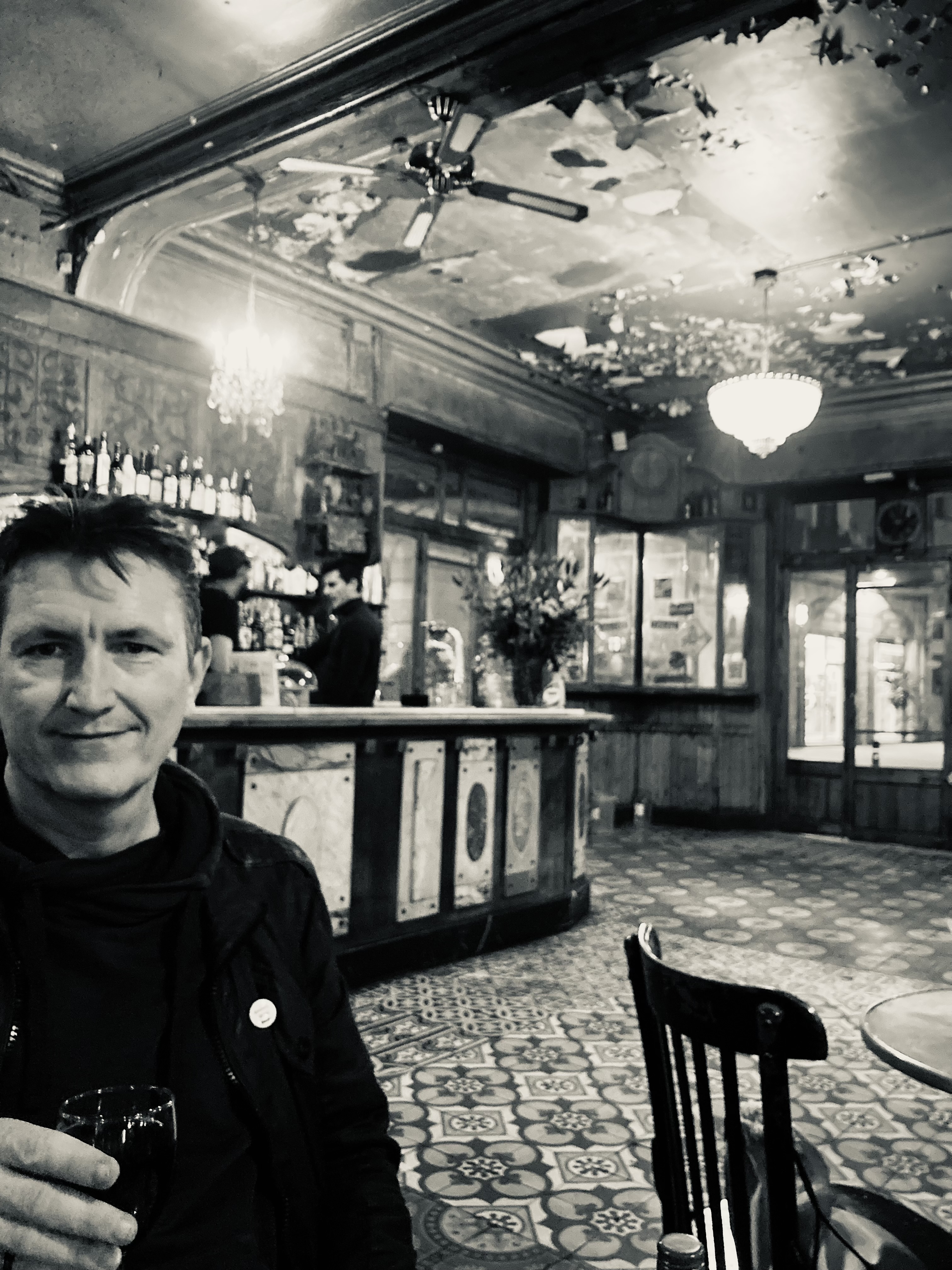
the photo? the significance of the photo? that’s me in a bar in barcelona that hemingway was meant to frequent. it was meant to have changed little since his time. unlike the bar. i think hemingway has changed writing forever.

moment 12

a body made of chicken wire, glue and paper. built up over the days, layer by layer, strip by strip, to become a hardened shell. then paint applied, a mixture of greens, browns and blacks. finally, a detachable monster’s head. a precious item. the performance arrives. muffled instructions received and misunderstood. a roaring entrance down the aisle to the stage. parents watching. a speech given, time to turn and leave. a pathway narrows until I’m stuck in rows. unable to move. the heat rises in the costume, the papier-mâché body seems so thin. stiffled laughter permeates the hall. parents come to the rescue, moving chairs. the monster is freed and makes a quick exit.

2022 and all that

Well, 2022 brought a number of changes which impacted on what I write here. I have been submitting a new novel for consideration. But primarily, I have been writing a lot of prose-poetry. This has led me to the new outlet for my writing of Spoken Word.

What is Spoken Word?

Spoken word is when you perform any piece of writing to a group of people. It is often poetry but can be a story, monologue, or something else. It is quite flexible as to format.

Due to writing a lot of prose-poetry and sharing at my favourite writing group, I was encouraged to attend a Spoken Word night. I went along, sat, watched, then thought: I want to set up one of those. And where better than my favourite bookshop in my local area. So far they have been going well and I have been exposed to some great fresh writing that excites me and always leaves me thinking. Such a variety is on offer. All unique voices that should be heard.

Children love Spoken Word and enjoy writing poetry so it is a great thing to do for World Book Week. Why not start by enjoying watching some Michael Rosen, Benjamin Zephaniah, John Hegley, Kate Tempest, or Anthony Joseph?

As well as Spoken Word, I have been plotting and writing another one. I have changed my approach and audience for it. I’m venturing somewhere new. It is challenging and exciting. I’m trying to apply some of the approaches I use for my prose-poetry to the novel writing. I’m not sure it will work. Only time can tell.

What have you been doing?

Pulling A Blank


22504F9C-90B1-4611-B70F-22C901E5A62C.jpeg

You will have noticed I haven’t written an entry for my blog for a while. There is no great mystery behind it. I was not kidnapped, transported to another planet or plummeted into a mystical realm like the children of Narnia. No. It is quite simple. I was going through what many writers go through at various points when writing: writer’s block.  I just couldn’t think of anything to write for my blog.

Maybe it was because my creative energies were being sapped by two other things: submitting my second book to Literary Agents (time consuming and somewhat soul destroying) and compiling the notes on my third book before settling down to editing proper. I’m still at both of these and they have become my obsessions.

This meant I had less time to just let my wander and play in the quiet moments. This is an essential part of writing. If you are told to ‘just write,’ often you’re mind goes immediately blank.

That’s why writing at school can be really hard. The blank page and your teacher asking you to come out with some great story just like that. And there are all the things you are told to remember: fronted adverbials, alliteration for effect, a simile or metaphor or two. No wonder you mind just freezes. How can anyone write under such pressure?

Take a moment and put your pencil down. Stare out the window. Watch the trees in the breeze, traffic passing or the rain fall. Take some calming breaths. Think about what you are interested in: A TV programme you watched; a computer game you play; a song you like; a pet you cuddle… Make that your story.

There are no rules when writing stories. You can have happen whatever you want. You are the magical master. If you want a tap-dancing zebra as a class teacher, so be it! You want to be skiing on the skin of a bowl of custard, go on! It is your world. Rule it.

The Writer’s Life

Writing and pen

When I visit schools, children often ask me questions about being a writer and what it is really like so I thought I would attempt to answer some of the most common questions I am asked here.

Are you rich?
The answer is no. Most writers are not rich. The average yearly wages for a writer is £10,500 so that means most writers have another job as well, like me. Unless, you are super succesful like JK Rowling. Then you can write all the time. I’m afraid to say I don’t live in a big house and have twenty-eight cats. I have two and a goldfish.

Are you famous?
No. Very few writers get recognised on the street. The ones that do tend to have been celebrities before they became writers, like David Walliams. They were famous for something else first. Of course, there are a few exceptions like Michael Rosen, Roger McGough or Anthony Horowitz who have also been on TV after their books became well-known. I’ve only been recognised in the street once by a girl whose school I had visited. She yelled, “Look, there’s that writer who came to my school. He’s going into that house!” Otherwise, I walk about never noticed. I could be sat by you and you wouldn’t know.

What do you do when you write? What’s it like?
When I write, I take myself out of the house away from distractions like the TV, cats, fish, reliable internet and go to a place I call ‘the office.’ There I can get endless cups of coffee for just £1.25.
I settle down at the table, look at the outline of my book I’m currently working on, open up my tablet and keyboard and begin writing. I write using a programme called Scrivener which was specially made for writers. While I write, I usually listen to music without voices to cut out any background noise that may distract me and put me off. I might write non-stop for an hour or three. It depends how easily the writing is coming. As I write, I talk to nobody except my characters and imagined audience. They are my only concern.
Writing can be lonely. You sit by yourself, not speaking, not knowing if your writing is any good or worth reading. You just hope it is and carry on. That is why I am also a member of two Writing Groups. There, I share my work, find out what people think of it, if my jokes work, and talk about writing issues such as the best way to solve a problem with point of view.
Sometimes things are different. Sometimes I get to meet my readers when I am invited to a school to do a talk or run writing workshops. Then I get to share my love of writing and talk about books and we do some writing together. It’s great fun.

Have you written any other books?
Yes. Three others but they’re not published yet. One is for grown-ups, one is a kind of Tolkien adventure, and another is about an elf which I’m sending to Literary Agents. I am also working on another one at the moment.

I hope all this helps clear up the things I’m most asked. If you’ve any other questions, just ask in the comment’s box below.